Sunday, December 27, 2020

Ten Years ago today: Henna

 Shaadi.com


I envy the idea of arranged marriage.  In fact, the concept of coming before a stranger minus a past or a bruised heart with the sole purpose of pledging to stand steady no matter life’s insanity has very real appeal.   In the Indian culture, arranged marriage is still very much common practice and many times it manifests in the form of a blind date set up by parents based on similarities, caste, income, level of education and social and family values.  The prospective bride and groom size each other up over a few meals and emails and if they like who has been placed before them, family rejoices and a wedding is soon to follow.  Of course, this concept does not translate into the western way.  We tend to scoff at the idea that our parents could possibly know our own hearts better than we do. We ignore the years our parents have seen and dismiss their lessons learned. We forget that they only want to protect us by setting us on our way unblemished.  (although I do cringe in horror just thinking of who my mom may have picked for me...)    Instead, we trample after love with the delicacy of elephants, time and time again, until some of our hearts start to resemble those dented canned peas hiding behind the overripe bananas on the grocery clearance rack.


 But sometimes.. oh yes, sometimes we get lucky.

Ameya and I came together, each bringing our own past.  After all, one cannot reach 31 years of age without having lived every one of those 31 years.  In our newly joined home, we have a room that I recently painted what I thought would be a lovely warm shade called ‘clove bud’  but actually turned out to be the color of the surface of the sun.  However, in the brutally cold Chicago, a pumpkin orange room thankfully goes a long way to inducing feelings of warmth.  In the ‘orange room’ we have a collection of gods; little Ganeshas, A stone Buddha, my rosaries from each country I’ve visited, a gold colored Lakshmi, and a lovely Shiva against a blue background.  Unfortunately, at one point my husband had let slip that this particular Shiva had been a gift to him from a past girlfriend and her family.  I then suggested that in our home together, it would be wise to leave items from the past safely in the past, especially since each time I glanced towards this proud god, he looked back with eyes that knew more of my husband than I did. But one does not simply give away Shiva, nor does one attempt to hide him behind other knick-knacks.  Shiva, is after all, the destroyer and by nudging him aside, one is foolishly asking to be taught a lesson...

A short time after Shiva and I grudgingly decided that we could share the same home, Ameya and I ran into someone I had once dated.  (For the sake of avoiding confusion, we’ll refer to him as ‘Rooney.’)  I stood next to my husband, made small talk and all the while I felt ashamed of myself because in the past, I had been in the wrong.  A few years back when I had been seeing ‘Rooney,’ neither of us were in a very steady place in life. He had been a friend for a long time and as a result, I had set unattainable expectations for him, foolishly overlooking the fact that he was clearly out of his depth. I did not take the time to build him up by telling him that he was attractive, smart and most of all kind (all things of which he was woefully unaware.)  I was not overly nice or supportive and to be blunt, I likely left him in worse shape than I had found him. I took his friendship for granted and for that I have been sorry ever since.  However, one does not blurt these things out when sitting next to one’s husband. So as I glanced at ‘Rooney,’ I gave an inward nod to Shiva, acknowledging a lesson well taught, and silently asked him to send some much deserved good karma in the direction of my past friend. 

Regrets, mistakes and insecurities do not magically dissipate upon completion of marriage vows and as I sat the night before my wedding, looking over my henna covered sticky arms, a thousand questions and fears raced through my mind.  The days leading up to the wedding had been full to bursting with checklists and travel and family and obligation and as a result, my first moments to sit and truly comprehend the magnitude of the step I was about to take, came just hours before our ceremony. Up until this point, the entire concept of marriage had always seemed slightly horrifying to me as I come from a family in love with the idea of love. They leap in so joyfully, headfirst, only to end up with brutal concussions for their trouble.  And while I admire the strength with which they jump, I had always been much more comfortable standing just a few paces away from the edge.  

However, In my work, I have had the privilege of singing for countless weddings and I have to say that all of the brides make it look so easy. (except for that one who started dropping ‘F bombs’ when I asked if she was ready to begin.) I never see any trace of a past walking with them down the aisle to the future.  And they always seem so relieved to finally place their hand in their husbands, as if the insanity is finally over rather than just beginning.. For Ameya and me....the insanity was truly just beginning. ;)

Bangkok is stunning and I have to say that it’s possibly the best place to contemplate having a pre-wedding panic attack.  We had had a mere two days between our plane touching down and our wedding, each overrun by multitudes of new people, sights and experiences and the exterior chaos had begun seeping inward. As culture dictates, the day before our wedding was set aside for the Mehendi celebration; a gathering in which the bride’s hands and feet are decorated with henna, thus beginning her transformation into a wife.  According to tradition, the mehendi usually takes place with the bride’s family.  However, since Thailand was a bit far to expect my family to travel (I myself nearly needed a horse tranquilizer for the flight..) Ameya’s best friend Sid and Sid’s entire family were standing in as my own.  From the time we landed in Bangkok until the moment I was handed over in marriage, I was a member of the Mahapatra clan, proud recipient of two lovely parents, a grandmother, two brothers, a sister-in-law, and a small dog, Rex. While Ameya had been staying with his family at the Hotel Lotus where our ceremony would take place, I had been staying in the Mahapatra home, a pretty 7th floor apartment with dark wood floors and light blue walls in the lush green Sukhumvit area of Bangkok. 


The day before the wedding, I awoke early, dressed in a pale green salwar kameez (skinny pants covered with a knee length tunic,) ate a very light breakfast in fear of having an upset stomach with henna covered arms, and settled in on the couch to be fussed over for the next couple hours. Sheena was a pretty and petite woman in her early 30s with a beautiful warm complexion adorned with purple eyeshadow, a silver nose ring, large earrings and long curly black hair. She began with one tiny curvy line on the inside of my arm, halfway between my wrist and elbow, and I watched in fascination as intricate designs burst outward, eventually encompassing my entire forearm and hand. She was using what looked like tiny foil pastry bags with the tips cut only slightly bigger than a ball point pen. Occasionally, I answered questions Sheena had seemingly asked only to realize that as she bent over my hands, she was chatting away on a phone which was permanently embedded in her ear.  


In an effort to get me to stop nervously biting my nails, Ameya had told me that henna is a manure based product, (as if a little poop is enough to get me to stop...) However, I did a bit of research on my own to discover that henna is thankfully, plant based (Lawsonia inermis.) The paste of ground henna (either prepared from a dried powder or from fresh ground leaves) is drawn onto the skin  and left on from a few hours to overnight. Once the dried paste is washed (or chiseled) off, a lovely rich brown stain is revealed.  Henna stains can last a few days to a month and I have read that the darker the stain, the more the brides’ husband and in-laws will love her. It is said that the longer the bride retains the mehendi, the more auspicious her future will be...or possibly it just tells that she is not effectively washing her hands after each bathroom break..


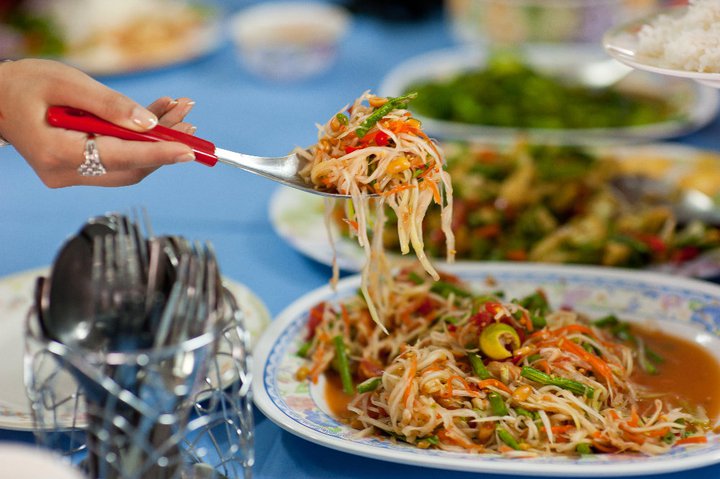
As the hours passed, the warm Thai sun came in from the balcony and the room began to fill with warmth and people. Two other henna artists had arrived and were in the process of covering the hands of my future mother and sister-in-law. Others wandered the apartment with cool drinks and plates of amazingly fresh and colorful Thai food (of which I was still terrified to eat.) My arms had been completely covered in henna and doused in lemon juice and sugar and I listened as women chatted lightly around me.  My friend, Joanna, had flown in to Thailand from Poland the day before and was ever present behind her camera lens, gleefully taking picture after picture, while trying to coax smiles out of camera shy sari draped ladies.  


Time passed as it has a habit of doing and people began to slowly trickle out of the apartment. As the bride must not step out of the house after the mehendi ritual until the wedding day, I was left to my own devices, quietly sitting in a chair on the 7th floor balcony, overlooking a Thai sunset.  While my henna dried and began cracking, I could hear children happily playing below, the drone of multiple air conditioners, and high pitched hindi music coming from an Indian soap opera inside the apartment.  I watched a huge grapefruit sun sink lower on the horizon while inhaling the smell of a thousand of dinners being prepared. I felt calm in watching the night slowly wash over Bangkok as the light from a million windows began to flicker over lush trees rustling in the warm breeze.  I found comfort in the continuity, in knowing that tomorrow, married or not, the breeze will still blow, the sun will still set, children will still play and the light from a million windows and countless lives will still flicker.


Saturday, December 26, 2020

Ten Years Ago Today

"God has been good to our family."

My husband and I sat on his parents bed the night before we were to fly home to Chicago.  As the pale blue walls and air conditioner kept the warm stickiness of the Thai night at bay, my new father-in-law reflected on the previous couple weeks. With a contented sigh, he stated, “God has been good to our family.” 

*****

A mere three weeks earlier, I had been in Chicago standing on an unsteady ladder shouting obscenities at a tiny nail which refused to detach itself from the wall I was about to paint. At the time, I had no thoughts of being pampered, dressed and draped in gold and silk, fed fresh fruit and vegetables till my bursting point... I had no concept of being introduced and crushed into perfume scented hugs, no thought of smiling till the muscles in my face stiffened and cramped... I had yet to think of the moment in which I would settle my hand for the first time into that of my husband’s.  Rather, my entire being was focused on that stupid f*#@ing nail and how I couldn’t move on to the next task on my ever growing list until it came out of the wall.  I realized maybe I had taken on slightly more than I could handle.  Perhaps it was not wise to pick the remaining two weeks before the wedding to level the floors, move my things (including the 687 lb piano,) paint and ready my “bachelorette pad” for the next bachelorette, manage my petite youth choir annual holiday sing along, maintain my usual herd of students, rehearse and sing multiple masses, and yet still have time to take in deep breaths while reminding myself of my impending bridalness.  With a hot flushed face and anger induced shaky hands, I raised my hammer intending to destroy the wall around the nail when my future husband chose that moment to wander into my apartment with McDonalds fries. Upon quickly noting my rage, he hastily stated that there was no need to stress as we could simply rent the apartment for an extra month to allow time to finish everything off upon our return from Thailand.  I teetered between the need to bludgeon him with my hammer and the desire to tell him that he was the most beautiful creature on earth before finally settling somewhere in between with french fries and sniffles. 

From that point on, things fell into place without the need for an extra month’s rent; nails fell gracefully out of walls, pale yellow paint glided smoothly on, the piano sailed up icy back stairs (with the help of some EXTREMELY strong men and hot chocolate,)  my youth choir brightened the day for many retirement home residents, Christmas eve masses were sung (though not my best work,) bags were packed by 3am and Christmas morning found me in a Lorazapan induced stupor holding my fiancé's hand in a death grip aboard a large plane hurling itself at Thailand.    

*****

On any given Sunday after a mass in which I am the cantor, I can be known to randomly hum the music...incessantly!  The morning after our Christmas Eve masses was no exception, much to the detriment of those sitting around me for the first 14 hour leg of our journey.  My internal soundtrack was limited to the alto part of the chorus to ‘Ding Dong Merrily on High,’ on loop and occasionally a note or two would slip out without my knowledge. After what must have been approx. 14,786 verses of playback, we safely landed in South Korea, home of the 2002 World Cup, and ironically in 2003, the second greatest importer of U.S. beef.  I suspect that there is actually a very small number of vegetarians rushing off to tour South Korea (and North Korea as well..) as even tiny innocent looking edibles manage to have beef stuffed inside somewhere. Despite, the overabundance of post-moo food and a soon-to-be husband standing gleefully in line at KFC, I was impressed by Seoul’s airport with it’s abundance of orchids and extremely zen bathrooms.   

Six hours and two trashy romance novels later, our second plane landed smoothly just outside of Bangkok; 10:30 pm local time, 10:30 am Chicago time and about 24 hours after our journey began.  Ameya and I stepped off the plane, took deep breaths and threw ourselves into the awaiting insanity... 


Monday, June 1, 2020

The whole world is raging.. and I along with it.

My husband and I have had many arguments in the past few days. “There is no excuse for riots and looting,” he says, “they are hurting their own cause.” My Indian husband comes from a family with a mother who anticipated his every need and a father who worked long days and years to ensure that he had the freedom to go to any school in the world. As a result, my husband is highly educated and respected, speaking English with no trace of an accent. He has experienced racism surprisingly few times, once in small town Michigan, once when being mistaken for a refugee in Greece, once on a train in Paris, and of course, Border Control at airports. Each time, he was left temporarily infuriated. However, my husband has never experienced hunger, he has never known the hatred of someone who should love him. and he has never been struck down by those who promised to serve and protect... over and over and over. 

I grew up in chaos and fear, a conveniently absent father, rotating “stepfathers,” constantly changing addresses and schools, the smell of bars and cigarettes wrapped up with Saturday morning cartoons. In school, I learned how to stay awake in class while hiding bruises and missing hair and I learned to sit in defiant silence when the state intervened and sat me before a counselor. I remember one Easter in particular, I was in either third or fourth grade, I walked alone to the Baptist church down the street and I looked with envy at all the beautiful hats, colorful hair clips and shiny shoes. I crammed into a pew with strangers, embarrassed by my too small skirt and out-of-place exposed pale legs, but those thoughts were forgotten when the woman next to me took my hand and the singing began. 

Each time the State, eager to get another child off their books, sought family reunification, I learned of the metallic quality of the taste of hopelessness. I built walls, trusted no one, and from behind my walls, I sneered at the kids who had family, the kids who could be in the school musical, the kids who had rides home from soccer practice, the kids who had parents who told them that they loved them, rather than how much they hated them. My jealousy and anger burned.. every. single. day. I graduated high school with straight Cs and the occasional D and I failed out of college just short of my degree. 

Though twenty years have passed, today, that little girl is raging inside of me. She is smashing windows and stealing shoes, because she knows that the only reason she has become who I am is because of our white skin. It wasn’t until my early thirties, when I was living in Chicago’s Uptown neighborhood and learning the names of the kids selling drugs on the corner, that my foster parents, the first people to help me do my homework, told me that they had said no to the placement of a little black boy, shortly before I was placed in their care. These chosen parents of mine didn’t say no out of racism, but rather out of fear that this little boy would have too many battles to fight in their rural white community. Even so, I think of this little boy every day. Has he found love and hope? Is he alive today? Is he smashing windows and raging at a system that has abused, humiliated and broken him? I don’t condone destruction, looting, and stealing, but I do empathize with the rage. The whole world is raging and I along with it. 

But my anger is so small in comparison to the anger, fear and bitterness aimed at an unjust centuries old society. George Floyd was just a couple years older than me. We would have been in school together. There are no words to encompass the horror of what was done to him. While window are being smashed, we should all be smashing through our own complacency. We should be signing up to tutor, calling our representatives, using our churches as points of outreach rather than selfishly serving ourselves. We should be working with schools in every neighborhood, to ensure that every child has a chance. We should be speaking up when witness to racism. To the little boy who’s place I took and to the man that he has become, let me stand next to you, holding your hand... much as the woman in church held my hand so many years ago. 

For a small sound of hope, I am attaching a recording from the Moria Refugee Camp. These women have endured countless abuses, a horrific journey and are still daily robbed of their humanity in Moria. Yet they sing and they teach me about who God is and what it means to hope for a better world.  


Saturday, September 7, 2019

Why I am here...

Boris Godunov changed my life. I am sure that the alcoholic composer, Mussorgsky would have enjoyed the irony of the fact that by setting his pen to paper, he was saving me... the daughter of an alcoholic.  As a sophomore in high school, I had just been taken back into foster care and I was in a new school surrounded by people I didn’t know or want to risk knowing. I was perhaps a little chubby, horribly awkward and I had the bad habit of accidentally washing my clothes with cherry chapstick inevitably left in one pocket. (still happens..) Algebra destroyed me, I missed my friends, my parents didn’t love me and at the ripe old age of 15 years, I was unbearably tired. 

I have forgotten so much of that time, though I eventually made beautiful friends and adjusted as most children are capable of doing. However, everything changed with my introduction to an ill-fated, slightly insane, 16th-century Russian czar. As the leaves began to crumble and the air took on a chill foreshadowing a brutal midwestern winter, our music class boarded a bus bound two hours west for Chicago. I sat staring out the window, wondering if the boy with the unsettlingly blue eyes would like me while a synopsis of Boris Godunov sat forgotten on my lap.

 Later that afternoon, I stared wide-eyed at my gilded surroundings from the luxury of my plush red chair as the lights flickered and dimmed at the Lyric Opera of Chicago. As the first strains of the orchestra picked up, all else left my mind, all troubles forgotten. By intermission, I had formed a link of empathy with my poor Boris and before the last notes died away, it was decided that I would be owned by this music.

Three Septembers later, I stood in the office of my new and first voice teacher and I was just as much an imposter as Dmitriy, the nemesis of my Boris. Luck and sheer naivety had gotten me into a university music program armed with only two songs, Caro mio ben and Bernstein’s Simple Song. Perhaps if I had known just a bit more, I would have never thought myself capable, but stupidity brings out the bravest warrior in each of us. I was hungry, I had nowhere to go if I failed and I simply wanted to sing.  

The path of my career has certainly been full of unexpected turns and steep drops. I have failed magnificently and I have succeeded quietly. Conceivably, I could have pushed harder and maybe found more of a place onstage, but being the center of attention never truly sat comfortably on my shoulders. Instead, as I became a competent musician, the fear of childhood and of closely avoided outcomes receded. Music made me independent, compassionate and powerful. 

Present day finds me thousands of miles from home on an island in the Aegean Sea. At times I look up to see a small boy in front of me holding his ukulele in the wrong hand, dirt under his nails, war in his past and his future unwritten. Other times I have an entire class in front of me, but I am drawn to the stubborn adolescent boy who refuses to participate. I watch him subtly until by the end of class I see that the light of interest has entered his eyes and his lips are mutely counting the beats of whole, half and quarter notes. Sometimes I look up to see a whole giggling choir squeezed into a tiny container, filling each molecule of space with their voices as they enthusiastically sing the spiritual I just taught them. And in a courtyard under a tree, a young girl sits, her rattling cough shaking her fingers from the neck of the ukulele while her intelligent eyes calmly absorb all. 

I am unapologetically rigid in my methods, expecting organization, respect and continuity. On these things I cannot compromise, because each time a student comes in front of me, I wonder if music and this child will choose each other. And if they do, I must make sure to arm this child with everything I can, so that when her journey begins, she will be stronger than I was. 


Why am I here?  Because they are. 

Side note... for any parents reading this post: please do not take your children to Boris Godunov for their first opera. I was a strange child and the outcome would likely not be the same. Try Mozart instead!   


Saturday, August 24, 2019

Grief

At St Gregory the Great on the north side of Chicago, we have everything we need. There is a beautiful organ and a choir loft that is safe and structurally sound. There is a grand piano, an ability to pay a music director and a rotation of green altar plants. Near Christmas, the smell of pine permeates, while spring is wrapped in Easter lilies. On any given Sunday, lemon and wax scented air from a recent polish welcomes parishioners. We have toilet paper in the bathrooms and coffee in the parish center kitchen. We have warmth in the winter and and freshness in the summer. We have friends and family and we have community and strength. 

Halfway around the world, on the island of Lesvos, there is a tiny hidden Catholic church, the only Catholic church on the island. Set back about about fifteen meters from Mytilene’s busy Ermou Street, the Catholic Church of the Assumption of the Virgin Mary is obscured from view due to the larger neighboring buildings and a wrought iron fence. Upon entering the church, one leaves behind the bustle and brightness of the market street, exchanging it for the calm, cool sanctuary of the interior. Built in the middle of the 19th century, and home to relics of St. Valentine, the nave of this tiny church stretches ambitiously for all of about twenty square meters. Though renovated in 2013, there are bubbles of moisture below the plaster on the faded color painted walls and to certain parishioners.. the choir loft is NOT an option. But despite the diminutive size of the church and it’s humble features, the blissful acoustics are a blessing to any classical singer who happens to wander through.  

There is a Greek mass on Saturday morning and a French mass on Sunday, separated by both a day and by a world of experiences. The French mass finds African believers pressed close together in small but sturdy pews, while others stand, their eyes fixed to God, their shoulders brushing their neighbors and their tired feet forgotten. 

In Chicago, I sit in St Gregory’s each Sunday with everything I need and yet I furiously challenge God, I rail at complacent humanity and I curse blind faith. Meanwhile, those who have lost nearly everything, those who have faced terror and fear, those who have put their trust in a tiny boat and the grace of God..They are found each week on their knees in the little church in the heart of Mytilene. 

Recently a young man who was a refugee from the Democratic Republic of Congo, drowned while crossing the Mediterranean with hope for a chance at life. This afternoon, the Church of the Assumption hosted the funeral. As the choir shuffled music and warmed up, the coffin was brought in with shouts and sobs echoing beyond the open doors to the street outside.  At the conclusion of the ceremony as the coffin was removed, a raw keening wail rose, the visceral harshness merging with the recessional hymn. The hairs on my arms raised and my face was wet with my inability to remain detached. 

In the coming days and years, I will remember the ache of singing broken by sobs. I will carry their cries and wailing with me, accompanied by the sound of hands desperately grabbing the wood of a coffin. Their humanity and grief cannot be forgotten. 

There is so much beauty here; a late night guitar, the taste of the sea, the light of a beautiful friend, voices raised as one, a snoring ginger kitten. But reality is harsh and unrelenting. Tonight a child died in the safe zone outside Moria. How do we reconcile these things? What are we doing as Christians to change things and to ease pain? Better yet, what can we be doing as humans. These are not rhetorical questions. What am I doing? What are you doing? It is time to get to work. 


Thursday, August 9, 2018

Statement of Proposed Research

STATEMENT OF GRANT PURPOSE
Jennifer Sherrill, Greece - Musicology
Songs in Transit: One Hundred Years Ago and Today

Dromoi is the name given to the musical scales of Greek Rembetiko music. Romantically translated, dromoi means roads or paths and as a musician sets her feet on the beginnings of a song or scale, a new path full of twists and turns is revealed. Rembetiko is the music of the refugee, the underdog, the outcast, the poor and the displaced. This music was born from fire and struggle, it’s birth rising from the ashes of the Greco-Turkish war. In 1922 as Smyrna burned, Greek, Armenian and Jewish refugees fled Turkey and flooded into Greece, bringing with them their food, culture, language and of course, music. They blended the Turkish scales (makamlar) with elements of Byzantine music while mixing in traces of pain, struggle and humor to contribute to the style of music known as Rembetiko.

Much the same as a hundred years ago, the island of Lesvos sits on the forefront of the mass movement of people. Since 2015, hundreds of thousands of refugees and migrants have landed on the shores, overwhelming a population of not quite ninety-thousand. Despite the obvious tensions that arise from the combining of differing cultures into close proximity, one benefit is that music on Lesvos is absolutely thriving and powerfully representative of multiple traditions.

My proposed project is multifaceted, encompassing elements of research, performance and teaching. With a Fulbright award, I will spend my time researching the rise of Rembetiko while immersing myself in the playing practices. Acting as a participant observer, I will work with Rembetiko musicians and teachers living on Lesvos in order to learn the songs and their connections to them. Each Rembetiko musician will choose one song which I will then research, focusing on the historical origins of the song and what is means to the musician personally.

Along side my work with Greek musicians, I will be teaching adult music classes through Mosaik, a community center working towards the goal of providing safety and warmth, community and dignity to the most vulnerable populations on the island. Using a qualitative approach, I will help Mosaik students pick songs of any genre that have been important to them throughout their present day journey. I will research their songs and work with them to tell the stories of how these songs have been important to them. I will present these songs in a final exhibit on the island and also weekly, in narrative blog form. Each week, I will post the story of one song from a Rembetiko musician beside the story of one song from a present day refugee in order to bridge the parallel cultures that are currently residing on Lesvos. My project will serve to fill a gap in existing research on the similarities of the origins and experiences of Rembetiko with the present day migratory movement of people and music.

My post Fulbright plan will be to present these stories of song in book form to coincide with the timing of the two hundred year anniversary of the start of the Greek war for independence and the one hundred year anniversary of the conclusion of the Greco-Turkish War. I will pursue publishing while targeting an audience of students of world music, geo-musicology and sociology. My subject will also appeal to those attempting to put individual faces to the overwhelming numbers heard in news stories about the economic and refugee crisis. My research and human interest project leads well into the next step of my academic path towards applying for a Ph.D in Ethnomusicology.

Throughout the process of my work on Lesvos, I will affiliate with Prof. Dimitris Papageorgiou, director of the Image and Cultural Representation Lab of The University of the Aegean. I will work with the cooperation of Mariza Vamvoukli, musical director at Mosaik and of Cantalaloun, an adult choir combining singers from Greek populations and vulnerable groups. I will also work with the guidance of Efi Averof, musicologist and president of the board of Athens based Polyphonica. I will look to these three accomplished advisors for access to existing research data, guidance on collection methods and advice on cultural sensitivity and musical accuracy.

There will be multiple languages spoken in the undertaking of this project and often times I will have to rely on recordings and the many talented multilingual members of the community. However, usable Greek will be integral to my success and to that end, I have enrolled in a modern Greek class for Fall 2018 at the University of Illinois at Chicago. I will continue the class through the spring semester while working independently with Greek music in order to give a present day purpose to the language before arriving to the island.

I have been incredibly fortunate to have had the opportunity to teach on Lesvos, but in leaving, I felt that I left work undone. In my eight weeks on the island, I discovered that community engagement is not an option, but a given. The community wraps around each newcomer, asking to share a cup of coffee, a song or a conversation. I will happily engage further, by working through Mosaik as a music teacher and TEOFL certified ESL tutor. While I will be teaching the basics of western music theory, chord shapes and structure, I will also incorporate elements of Rembetiko, teaching students the fundamentals for improvising within each dromos, using Rembetiko to help empower and connect refugees to the culture and community around them. I will also lend my voice to Cantalaloun, an intercultural adult choir. I will lend my organizational and cantoral skills to the Catholic Church of the Assumption of the Virgin Mary in Mytilini in order to help them build their music program. And I will lend my ear and heart as a friend.

When I first heard the music of Rembetiko, I felt an unexpected moment of recognition. There is strength and resilience in the songs of those who passed through Lesvos one hundred years ago. The first time I played a familiar English song only to hear it sung back in a language I didn’t know, I began to understand that that same strength fills the music of those passing through today. A Fulbright award will enable me to give voice to untold stories of struggle, joy and song while allowing me to teach in a community that is so incredibly hungry to learn. I will work to help create and present a common language of music between a small population of residents and refugees in order to find understanding and warmth. Lesvos sits in a unique place between beauty, hope, chaos and fear. There is much work to do and my hands are able


Wednesday, August 8, 2018

Fulbright Personal Statement


PERSONAL STATEMENT 
Jennifer Sherrill: Greece - Musicology
Songs in Transit: One Hundred Years Ago and Today

I am a foster child. I grew up in the system, traded back and forth between families of strangers and my own mother. I was incredibly lucky that I had a singing voice which allowed me to attend university on scholarship. However, I was ill prepared for the demands of the program and I failed out spectacularly. In the intervening years, I have detasseled corn, worked my way through restaurants as a dishwasher, waitress, hostess and line-cook, cleaned as a hotel maid, interrupted dinners as a telemarketer, and ran countless soccer games as a referee. I have since, completed my Bachelor of Arts and served as a church musician and youth choir director for over a decade. I have taught in Peru and worked as an ESL tutor to an immigrant population in Chicago’s Centro Romero. I have built a successful teaching studio and I am one semester away from completing my Masters in Vocal Performance with honors. I am not a stranger to hard work, I do not look away from pain and after a lifetime of lessons, I am not afraid to learn. 
Despite my own hard work, I would not be as I am today without the helping hands of so many who made sure that I knew I had value. These people gave me a safe place, books and a hunger for the world. Recently, I found myself on the other side of the world in a small, lush courtyard. A young girl sat in front of me, her fingers shaping the harmony of Sol on her ukulele. She looked up, her smile free and in her eyes I saw equal parts pain, potential and strength. In that moment, I understood the love and the risks taken by those who chose to stand by me. Many on Lesvos have experienced trauma that I am unable to comprehend. However, I am familiar with fear and the desperation to find balance in the middle of chaos. A ukulele, a song, or telling a story may seem small frivolous things, but when one’s heart is tired, they can be everything. 
Even now as I write my statement in my Chicago home, my day is punctuated by little notes of encouragement from the island. There is Aref, a quiet young man who takes every class he can, acquiring any skill available. He makes beautiful art and as I left Lesvos, he gave me a pair of earrings with delicate paper cranes dangling optimistically. There is Antonis, the luthier who lovingly built my baglamas. There is Mariza, a musician who can step into chaos and create. And there is the young Afghani couple, Mehdi and Faisa, who spend their nights separated and surrounded by uncertainty in the Moria refugee camp. Yet they spend their days in classes leaning close to each other. Our six weeks of classes were outside and in response they, who have nothing, brought me bug spray. These people humble me, and it is for them that I ask to go back.   

From the perspective of an adult, I have looked back to discover that Greece has been feeding me for years. I was fed where I grew up, working in the restaurants surrounded by rapid fire Greek and I was fed at the dinner table of my college friend Tony Kidonakis, whose father would feed me past a rational bursting point. It was this warmth and the knowledge that I could help in a small way, that called me to Greece for the first time. I was not surprised to find that upon arrival, Greece continued to feed me, quite literally. I fell in love with her tastes, her songs, her people, her community and her stories. In going back, both my stomach and heart will be fed. 


1st draft

I am a foster child. I grew up in the system, traded back and forth between families, my own mother and the government. I was incredibly lucky that through no work of my own, I had a singing voice which allowed me to attend university on scholarship. However, I was ill prepared for the demands of the program and I failed out spectacularly. In the intervening years, I have detasseled corn, worked my way through restaurants as a dishwasher, waitress, hostess and line-cook, cleaned as a hotel maid, interrupted dinners as a telemarketer, and served as a referee for countless soccer games. I have since, completed my Bachelor of Arts and served as a church musician for fifteen years, directing the youth choir for eleven of those years. I have taught in Peru and Greece and worked as an ESL tutor to an immigrant population in Chicago’s Centro Romero. I have built a successful teaching studio on Chicago’s north side and I am one semester away from completing my Masters with honors. I am not a stranger to hard work, I do not look away from pain and after a lifetime of lessons, I am not afraid to learn. 

However, despite my own hard work, I must admit that I would not be as I am today without the helping hands of so many who have loved me. I did not belong to these people, but they made sure that I knew I had value. As my own family was breaking apart, there was always a couch for me, a meal, a conversation and love. These people gave me books and a hunger for the world around me and it is to them that I owe everything I am. Until now, I have not understood their motives. I could not make sense of why they would take care of a child who was not their own. Recently though, I found myself on the other side of the world in a small courtyard with the sun creating golden shadows through the leaves of the trees above. A young girl, soon to become a woman, sat in front of me, her fingers making the shape of the harmony of Sol on her ukulele. She looked up, her smile free and as her eyes locked with mine I saw equal parts pain, potential and strength. In that moment, I understood the love and the risks taken by those who chose to stand by me.

A Fulbright grant will allow me to use my skills as a classically trained musician, to analyze the structure of Rebetiko in order to discover the personal pull. A Fulbright will give me the means to research the rise of Rebetiko and how it relates to the refugee crisis today. A Fulbright will give me the luxury of spending a year’s worth of evenings listening to and playing Rebetiko with an island full of amazing musicians and friends. A Fulbright will help me to solidify Greek as a  language that I am capable of using. A Fulbright will let me lend my knowledge of classical, American folk and gospel in order to help expand the repertoire of Mosaik’s intercultural choir. A Fulbright will allow me the time I need to teach in a refugee community that is so incredibly hungry to learn. A Fulbright will enable me to use my skills as a creative writer to give voice to untold stories. A Fulbright will help me to create a common language of music between a small population of refugees, Greeks and volunteers in order to find understanding and laughter.  But most of all, a Fulbright will give me the chance to repay and pass on the love that was given to me.

Love and music saved me and gave me sanity in the midst of chaos. Lesvos sits in a unique place between beauty, hope, chaos and fear. There is much work to do and my hands are able. 

2nd draft..

I am a foster child. I grew up in the system, traded back and forth between families, my own mother and the government. I was incredibly lucky that through no work of my own, I had a singing voice which allowed me to attend university on scholarship. However, I was ill prepared for the demands of the program and I failed out spectacularly. In the intervening years, I have detasseled corn, worked my way through restaurants as a dishwasher, waitress, hostess and line-cook, cleaned as a hotel maid, interrupted dinners as a telemarketer, and served as a referee for countless soccer games. I have since, completed my Bachelor of Arts and served as a church musician for fifteen years, directing the youth choir for eleven of those years. I have taught in Peru and Greece and worked as an ESL tutor to an immigrant population in Chicago’s Centro Romero. I have built a successful teaching studio on Chicago’s north side and I am one semester away from completing my Masters with honors. I am not a stranger to hard work, I do not look away from pain and after a lifetime of lessons, I am not afraid to learn. 

Despite my own hard work, I must admit that I would not be as I am today without the helping hands of so many who have loved me. I did not belong to these people, but they made sure that I knew I had value. As my own family was breaking apart, there was always a couch for me, a meal, a conversation and love. These people gave me books and a hunger for the world around me and it is to them that I owe everything I am. Until now, I have not understood their motives. I could not make sense of why they would take care of a child who was not their own. Recently though, I found myself on the other side of the world in a small courtyard with the sun creating golden shadows through the leaves of the trees above. A young girl, soon to become a woman, sat in front of me, her fingers making the shape of the harmony of Sol on her ukulele. She looked up, her smile free and as her eyes locked with mine I saw equal parts pain, potential and strength. In that moment, I understood the love and the risks taken by those who chose to stand by me. My students on Lesvos have experienced trauma that I am unable to comprehend. However, I am familiar with fear and the desperation to find balance in the middle of chaos. A ukulele, a song, or telling a story may seem small frivolous things, but when one’s heart is tired, they can be everything. 

A Fulbright grant will allow me to use my skills as a classically trained musician, to analyze the structure of Rebetiko in order to discover the personal pull. I will have the means to research the rise of Rebetiko and how it relates to the refugee crisis today. I will enjoy the luxury of spending a year’s worth of evenings listening to and playing Rebetiko with an island full of amazing musicians and friends. Through the course of the year, Greek will become a language that I am capable of expressing myself with every day. I will be able to lend my knowledge of classical, American folk and gospel in order to help expand the repertoire of Mosaik’s intercultural choir.  A Fulbright will give me the time I need to teach in a refugee community that is so incredibly hungry to learn and it will enable me to use my skills as a creative writer to give voice to untold stories. I will work as hard as I can to help create a common language of music between a small population of refugees, Greeks and volunteers in order to find understanding and laughter. 

 Lesvos sits in a unique place between beauty, hope, chaos and fear. There is much work to do and my hands are able. 


3rd draft... and my favorite


PERSONAL STATEMENT 
Lesvos, Greece - Sociology and Music

I am a foster child. I grew up in the system, traded back and forth between families, my own mother and the government. I was incredibly lucky that through no work of my own, I had a singing voice which allowed me to attend university on scholarship. However, I was ill prepared for the demands of the program and I failed out spectacularly. In the intervening years, I have detasseled corn, worked my way through restaurants as a dishwasher, waitress, hostess and line-cook, cleaned as a hotel maid, interrupted dinners as a telemarketer, and served as a referee for countless soccer games. I have since, completed my Bachelor of Arts and served as a church musician for fifteen years, directing the youth choir for eleven of those years. I have taught in Peru and Greece and worked as an ESL tutor to an immigrant population in Chicago’s Centro Romero. I have built a successful teaching studio on Chicago’s north side and I am one semester away from completing my Masters with honors. I am not a stranger to hard work, I do not look away from pain and after a lifetime of lessons, I am not afraid to learn. 
Despite my own hard work, I must admit that I would not be as I am today without the helping hands of so many who have loved me. I did not belong to these people, but they made sure that I knew I had value. As my own family was breaking apart, there was always a couch for me, a meal, a conversation and love. These people gave me books and a hunger for the world around me and it is to them that I owe everything I am. Until now, I could not make sense of why they would take care of a child who was not their own. Recently though, I found myself on the other side of the world in a small courtyard with the sun creating golden shadows through the leaves of the trees above. A young girl, soon to become a woman, sat in front of me, her fingers shaping the harmony of Sol on her ukulele. She looked up, her smile free and as her eyes locked with mine I saw equal parts pain, potential and strength. In that moment, I understood the love and the risks taken by those who chose to stand by me. My students on Lesvos have experienced trauma that I am unable to comprehend. However, I am familiar with fear and the desperation to find balance in the middle of chaos. A ukulele, a song, or telling a story may seem small frivolous things, but when one’s heart is tired, they can be everything. 
Even now as I write my statement in my Chicago home, my day is punctuated by little messages and notes of encouragement from the island. They are not so far away. There is Aref, a quiet young man who takes every class he can, acquiring any skill available. He makes beautiful art and as I left, he gave me a pair of earrings with delicate paper cranes dangling optimistically. Martins, a smiling man from the Congo, spreads warmth everywhere he goes. Despite constant setbacks and struggles with claims for asylum, he always has a smile to share and a song to sing. There is the beautiful young Afghani couple, Mehdi and Faisa, who spend their nights separated and surrounded by ugliness in the Moria refugee camp. Yet they spend their days in classes leaning close to each other. Our classes were outside and in response they brought me bug spray. And there is Arash, a determined Iranian man who has since moved on to Athens. Even though he is angry with government and disillusioned by bureaucracy, he rushed without hesitation to give support and strength to those affected by the Athens fires. These people humble me, and it is for them that I ask for time.   
A Fulbright will give me the time I need to teach in a refugee community that is so incredibly hungry to learn and it will enable me to use my skills as a creative writer to give voice to untold stories. I will work as hard as I can to help create a common language of music between a small population of refugees, Greeks and volunteers in order to find understanding and laughter. 


 Lesvos sits in a unique place between beauty, hope, chaos and fear. There is much work to do and my hands are able.


4th draft..
PERSONAL STATEMENT 
Jennifer Sherrill: Greece - Musicology
Songs in Transit: One Hundred Years Ago and Today

I am a foster child. I grew up in the system, traded back and forth between families of strangers and my own mother. I was incredibly lucky that I had a singing voice which allowed me to attend university on scholarship. However, I was ill prepared for the demands of the program and I failed out spectacularly. In the intervening years, I have detasseled corn, worked my way through restaurants as a dishwasher, waitress, hostess and line-cook, cleaned as a hotel maid, interrupted dinners as a telemarketer, and ran as a referee for countless soccer games. I have since, completed my Bachelor of Arts and served as a church musician and youth choir director for over a decade. I have taught in Peru and worked as an ESL tutor to an immigrant population in Chicago’s Centro Romero. I have built a successful teaching studio and I am one semester away from completing my Masters in Vocal Performance with honors. I am not a stranger to hard work, I do not look away from pain and after a lifetime of lessons, I am not afraid to learn. 
Despite my own hard work, I would not be as I am today without the helping hands of so many who made sure that I knew I had value. These people gave me a safe place, books and a hunger for the world. Recently, I found myself on the other side of the world in a small, lush courtyard. A young girl sat in front of me, her fingers shaping the harmony of Sol on her ukulele. She looked up, her smile free and in her eyes I saw equal parts pain, potential and strength. In that moment, I understood the love and the risks taken by those who chose to stand by me. Many on Lesvos have experienced trauma that I am unable to comprehend. However, I am familiar with fear and the desperation to find balance in the middle of chaos. A ukulele, a song, or telling a story may seem small frivolous things, but when one’s heart is tired, they can be everything. 
Even now as I write my statement in my Chicago home, my day is punctuated by little notes of encouragement from the island. There is Aref, a quiet young man who takes every class he can, acquiring any skill available. He makes beautiful art and as I left Lesvos, he gave me a pair of earrings with delicate paper cranes dangling optimistically. There is Antonis, the luthier who lovingly built my baglamas. There is Mariza, a musician who can step into chaos and create. And there is the young Afghani couple, Mehdi and Faisa, who spend their nights separated and surrounded by ugliness in the Moria refugee camp. Yet they spend their days in classes leaning close to each other. Our six weeks of classes were outside and in response they, who have nothing, brought me bug spray. These people humble me, and it is for them that I ask to go back.   

When I first heard rebetiko, I had an unexpected reaction of recognition.There is strength and resilience in the songs of those who passed through Lesvos one hundred years ago. The first time I played a familiar English song only to hear it sung in a language I didn’t know, I began to understand that that same strength fills the music of those passing through today.  A Fulbright will allow me to teach in a community that is so incredibly hungry to learn and it will enable me to give voice to untold stories of song. I will work to help create a common language of music between a small population of Greeks and refugees in order to find understanding and warmth.